Bubble Wrap:
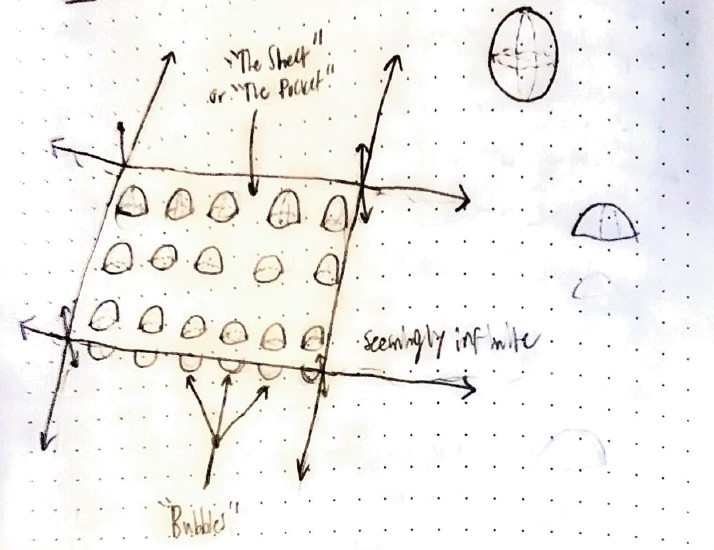
Approximate representation of the 133 Seas multiverse. Each bubble is an individual reality/universe, each of which has its own set of 3 spatial dimensions. The sheet is a "connective tissue" between the bubbles, keeping them oriented at specific coordinates within the sheets own spatial dimensions. Technically, the multiverse is many sheets of "bubble wrap" stacked on top of each other in a seemingly infinite bubble space, lending the totality of the sheets a total of 3 spatial dimensions to themselves.
Early explorers of the multiverse thought that the sheets were an external pocket universe from which one could travel to other universes, which is why the collective of sheets is often called "The Pocket."
Time:
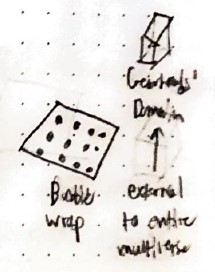
A universal time axis (whose direction is determined by entropy) exists across the multiverse, and all of its eddies and intricacies are governed and managed by the Time Lord and his Gearheads. This means that time passes, in some sort of sense, "at the same rate" in each reality (not in a literal sense, due to gravitational and velocity-related time dilation, but it is a close enough way to think about it).
Physics:
Every universe obeys the same underlying physics, and those physics are extended into the Pocket. This is because of two things:
- Any bubbles that do not have the same underlying physics as the Pocket cannot become embedded within the sheets of the Pocket, and so cannot be reached through it (and thus, usually, at all).
- Most universes that are born with unique physics are not stable and, in many cases, cannot even fully form. These bubbles are not very long-lived, and so are not very common or easy to find intact.
Travel:
Travel within the Pocket or any particular universe is as simple as traversing the three spatial dimensions inherent to those spaces. Travel from a bubble to the Pocket or vise-versa, however, is more complicated; one needs a way to transform their coordinates on one set of spatial dimensional axes into coordinates on the other set (technically, calling it a transformation/coordinate transformation is misleading, as the term calls to mind the mathematical concept of the same name. Another term for this process could be a coordinate "transplantation," but this is also not entirely accurate. The process seems to somehow be simultaneously mathematical and physical in nature). This process is very difficult to do, and has only ever been mastered by a few groups.